A Christian Zionist on the Hot Seat: Huckabee vs Tucker
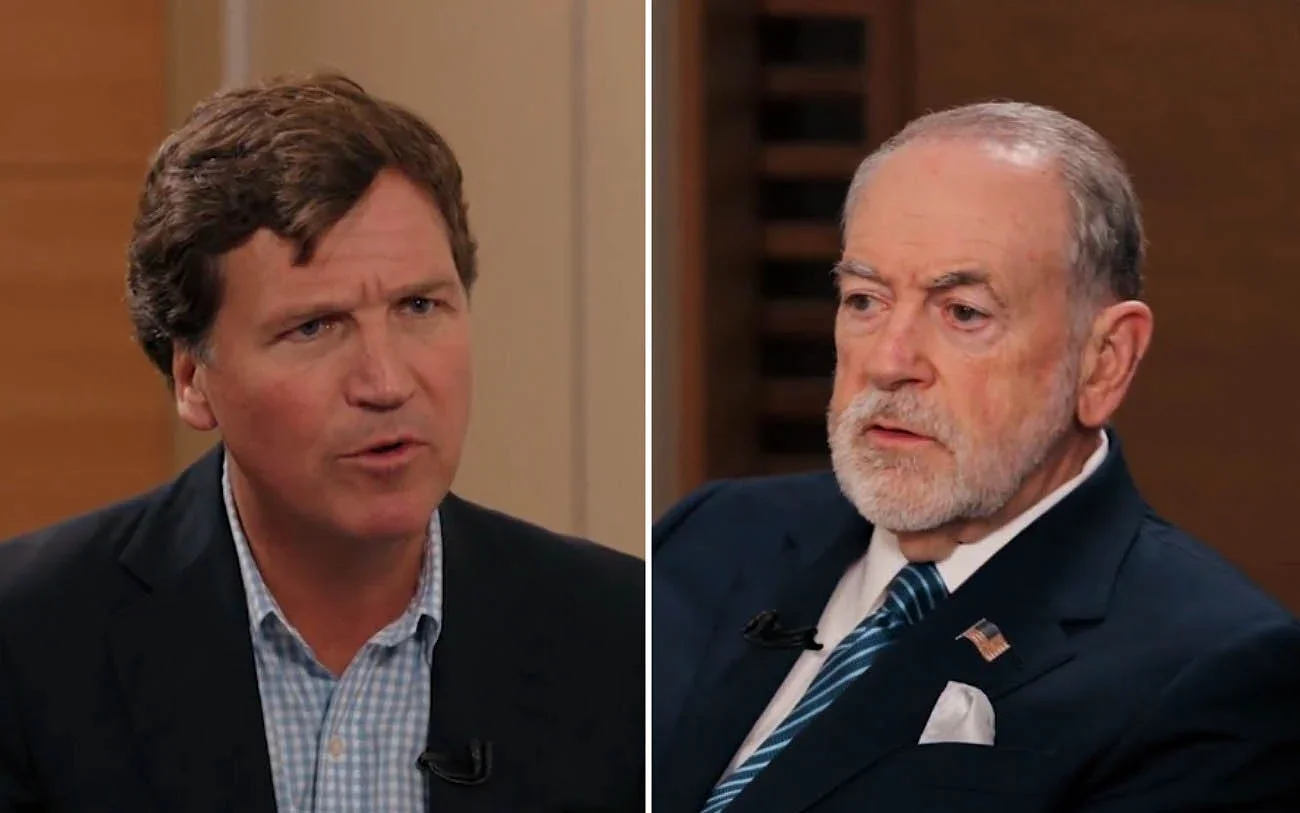
Tucker Carlson interviews U.S. Ambassador Mike Huckabee
I just watched the 2½-hour interview Tucker Carlson did with Mike Huckabee a few days ago, and I’d encourage you to watch it too. I found it genuinely thought-provoking—partly because I haven’t spent much time studying either man. Huckabee is a former governor of Arkansas, a Baptist pastor, and he now serves as the U.S. ambassador to Israel. Tucker Carlson is a famously provocative media personality who also identifies as a Christian. The interview was recorded in Israel, and Tucker pressed Huckabee with difficult questions about the legitimacy of Israel as a secular nation-state—and about who, exactly, deserves citizenship there.
I’ve known for a long time that the political and religious tensions surrounding Israel and its neighbors are extraordinarily complex. Those tensions even reach into our own community, especially since my family has relationships with at least one family that identifies as Palestinian. And I should admit something else up front: my own personal history with Islam is uncomfortable. After living for a year in the Middle East, I moved from being a Christian who simply regarded Islam as a false religion to someone who sees it as spiritually and socially destructive. Some of the most violent and hateful acts I’ve ever witnessed have come out of the Islamic system. So my perspective is not neutral; it’s biased against Islam.
For me, there is no clean, obvious answer to the Israel–Palestine conflict. The water gets muddy quickly when you realize that “Jewish” can function as an ethnic category, a religious category, or both—with overlap that is real but not always definitional. And as a Christian, I believe the Bible is inspired and authoritative in everything it addresses. Yet it’s hard to have a good-faith debate when the basic terms aren’t agreed upon.
A prime example is Galatians 6:16, where Paul speaks of “the Israel of God.” Depending on one’s theological framework—especially dispensational versus covenantal—“Israel” can mean either (1) the physical offspring of Abraham (an ethnic category) or (2) the spiritual descendants of Abraham through faith in Christ (a covenantal category). My own view is that Paul includes New Testament Christians in “the Israel of God.” Much of the New Testament, and Galatians in particular, addresses mixed congregations of ethnic Jews and Gentile believers. It makes sense to me that Paul would apply “Israel” covenantally to a community defined by faith in the Messiah rather than merely by ethnicity.
Because I read Scripture from a more covenantal than dispensational perspective, I tend to see deeper continuity between Old and New Testaments. Practically, that means I think many of God’s promises to Old Testament Israel reverberate into the life of the New Testament church—though not always in simplistic or one-to-one ways. And that matters here because the modern state of Israel typically justifies itself from a blend of sources: theological narrative, historical claims, international law, and military outcomes. In this moment, I’m most interested in the theological claim.
Tucker came into the interview with a few central questions, and—frustratingly—he rarely got clean answers. Huckabee identifies as a “Christian Zionist,” and Tucker wanted him to define what that means. Huckabee described it as a Christian who believes the Jews have a right to a homeland. But when Tucker pressed further—on what basis that right is grounded—Huckabee’s answers felt like an amalgam: biblical precedent, international agreement, and military success, all woven together.
And here’s where the messiness shows itself. If we appeal to the Bible alone as justification for Israel’s land, the borders extend from Egypt to the Euphrates (Genesis 15)—an enormous territory that today includes parts of multiple modern states. If we appeal to modern history, the border story shifts dramatically around the 20th century, especially the aftermath of World War II and subsequent treaties and wars. If we appeal to military conquest (or military survival), Israel’s “legitimacy” becomes tied to what it can hold and defend—though even that story changes, as with the return of the Sinai Peninsula to Egypt. So which source defines Israel’s boundaries: Scripture, international agreements, or battlefield outcomes? There isn’t an easy answer.
Tucker then moved to a related question: Who are the Jews who have a right to live there? At first glance, the answer seems obvious: Jewish people. But even that quickly becomes complicated. The modern nation of Israel was formed, in large part, to provide a homeland for the Jewish people—conveniently in a region with deep Jewish history. Yet in the establishment and expansion of that homeland, many other families—who also had lived in those areas for generations—were displaced. So whose history establishes a right to remain? And does Israel’s secular government ground its legitimacy primarily in biblical history, in legal agreements, or in political power?
Christians often say, rightly, that God is sovereign over political outcomes. He can use unrighteous rulers to accomplish righteous purposes, even when their motives are compromised. God’s motives are not. And God’s goodness is not dependent on our emotional comfort with the complexities; his goodness is definitional—part of his nature.
One of the most confusing elements in this discussion is Israel’s “right of return,” which grants certain Jews the legal right to immigrate and gain citizenship. But that raises another question: which Jews? My understanding is that ethnic Jews who convert to Christianity can forfeit that right, while a person with no ethnic Jewish connection who converts to Judaism may be able to claim it. That’s a striking example of how the lines get drawn: sometimes by ethnicity, sometimes by religious affiliation, and sometimes by a combination that doesn’t map neatly onto the biblical categories people assume.
That tension gets sharper when you consider Paul’s argument in Romans 9:
“For not all who are descended from Israel belong to Israel… This means that it is not the children of the flesh who are the children of God, but the children of the promise are counted as offspring.”
If we take Paul seriously, then “Israel” cannot be reduced to biology alone. It becomes a category shaped by promise and faith. Which creates a provocative thought experiment: if Christ is the true Israel—the faithful Israelite who fulfills Israel’s calling—and believers are united to Christ, then in a sense the people of God are the community defined by union with him. If you follow that line all the way down, you end up with a spicy conclusion: maybe the land belongs to Christians. That’s a hot take, and I’m not presenting it as a policy proposal. I’m simply pointing out how quickly biblical categories complicate modern political claims.
Huckabee also leaned on Israel’s military survival as a marker of legitimacy. Historically, most nations can point to battlefield outcomes as part of their story. But Israel’s claim often functions differently: it is treated as a unique case because it is tethered—at least rhetorically—to sacred history. Tucker raised the analogy of Great Britain: an ethnic population has existed there for a very long time, its religious character has shifted dramatically, and yet no one debates whether the British “deserve” to live in Britain. Britain’s legitimacy isn’t typically argued from Scripture. Israel’s often is.
And that returns us to the central question: Is modern Israel the same as Old Testament Israel? I don’t subscribe to crude replacement theology. I do believe God’s purposes for ethnic Jews matter, and that his covenants aren’t disposable. But if Christ is the fulfillment of the Old Testament, then how should Christians understand the status of the Jewish people apart from Christ? From a New Testament standpoint, it seems they are an ethnic people with profound historical significance who are, at present, living in unbelief regarding God’s climactic revelation in Jesus. That reality should produce humility and grief, not triumphalism. It also raises another question Christians sometimes ask: Is it our responsibility to help prophecy become a physical reality? I’m not convinced we’re called to engineer history. But I am convinced we are called to love our neighbor, to oppose needless suffering, and to bear witness to Christ.
I’ve also been thinking about what “rights” actually are. In the United States, we proudly claim that our rights are “unalienable” and endowed by God. In one sense, that’s true—human dignity is real because humans are made in God’s image. Yet in the practical realm, rights are protected only when there is power to enforce them. Laws, courts, and institutions are the mechanisms that prevent rights from being merely theoretical. So what power enforces Israel’s “right” to exist? In obvious terms: the Israeli military and significant support—financial, diplomatic, and strategic—from the United States. In ultimate terms: the providence of God, who raises up nations and brings them down. If God wills Israel to endure, it will endure. If he wills the Palestinian people to endure, they will endure. And if you read the Old Testament honestly, you’ll see that God often preserves and judges peoples simultaneously—disciplining, refining, and exposing hearts without surrendering his sovereignty.
Another portion of the interview that caught my attention was Huckabee’s positive mention of the Abrahamic Family House in Abu Dhabi—a complex that includes a mosque, a church, and a synagogue, framed as a cooperative space for Jews, Christians, and Muslims. It’s an interesting idea, especially coming from a religious tradition that has historically shown little tolerance for dissent. Their public messaging emphasizes learning rituals and promoting mutual understanding. But my concern is that it treats religious practice as the main point, rather than truth. Christianity, Judaism, and Islam are not merely three different ritual systems; they make mutually exclusive truth claims at the deepest level. So I find myself questioning why Christian leaders would endorse a project that—at least in its stated purpose—elevates rival truth claims under the banner of harmony. Some will argue it creates evangelistic opportunity. Maybe it does. But that rationale can easily become wishful thinking if it contradicts the project’s explicit goals.
None of these reflections yields a clean, actionable solution. If anything, this interview reinforced how difficult it is to translate sacred history into modern political legitimacy without either flattening the Bible or weaponizing it. Theocracy rarely produces good outcomes for populations that don’t share the faith of the ruling class—even if I also believe moral reality is objective and that societies flourish when shaped by true moral goods.
At the same time, I do believe God endorses secular governing authorities in a limited but real sense. Jesus tells us to render to Caesar what belongs to Caesar and to God what belongs to God. Christ never attempted to overthrow Rome in order to establish a religious state. Christianity aims at conversion and discipleship—at hearts and worship—more than it aims at capturing political machinery. So perhaps the best we can do is pursue policies that reduce suffering, protect the vulnerable as much as possible, and seek a stable peace, while recognizing that no arrangement will be morally pure in a fallen world.
I don’t know the answer. But I do trust God’s sovereignty—and I’m reminded that complicated history does not threaten God’s rule. It just exposes how much we want the world to be simpler than it is.