

A Man of Inward Humility
The disciples brought their own scoreboard to Jesus: "Who is the greatest in the kingdom of heaven?" Jesus responded by calling a child into their midst and saying, "Truly, I say to you, unless you turn and become like children, you will never enter the kingdom of heaven. Whoever humbles himself like this child is the greatest in the kingdom of heaven" (Matthew 18:1-4).
The disciples wanted a ranking. Jesus gave them a child. In their world, a child possessed little status, power, or influence. A child had no resume to display and no position to defend. By placing that child before them, Jesus overturned their definition of greatness.

The Servant’s Path to Glory: A Look At Philippians 1
Epic stories teach us to look for glory in familiar places: the battlefield, the throne room, the dangerous quest, and the hero whose name survives long after his death. The ancient Greeks called this kind of renown kleos, which means the glory of having one’s deeds celebrated and one’s name remembered.

For Teachers: Planting, Watering, and Waiting
Teachers choose work that matters. They enter classrooms, hallways, and practice fields knowing that every day will bring something unexpected. Some students arrive attentive and eager to learn. Others arrive carrying pressures, fears, and disappointments their teachers may know nothing about.

A Tribute To Alicia Miehe
On an ordinary evening at Central Church, I would often notice a small white car parked near the entrance. Without a doubt, I knew Alicia was still inside, working long after most had gone home. She was probably preparing for the next Come Alive dinner or quietly taking care of one of the countless responsibilities that made ministry possible.

At 250 Years: The American Story Part 2: Colonies and Commerce
Now we turn to the English colonies. Here we find one of the great tensions that will mark the American story from the beginning. Some colonies were driven by profit, land, and survival. Others were driven by religious freedom, reform, and the hope of building a godly society.

At 250 Years: The American Story Part One: Encounter and Conquest
Before Europeans ever called this land “America,” it was already filled with peoples, places, languages, cities, farms, governments, and stories. Any faithful account of American history must begin there.

There Is No Other Stream
Proverbs 1:7 says, “The fear of the Lord is the beginning of knowledge; fools despise wisdom and instruction.” The world tells us there are many streams, many paths, many truths, and many ways to live. Scripture tells us there is one stream that leads to life. There is one path of wisdom. There is no other stream.

When Rules Are Not Enough
Can a leopard truly change his spots?
That question from Jeremiah 13:23 presses on every parent, grandparent, teacher, mentor, pastor, and friend who has ever prayed for someone they love to change. We long for our children to grow in wisdom. We long for our students to walk in self-control. We long for adult children to return to Christ. We long for cold spouses, wandering friends, and weary church members to be renewed in faith. But wanting change and being changed are not the same thing.

From Past Failure to Future Faithfulness: Parenting Advice From Deuteronomy
There are certain moments when the past refuses to stay in the past. A mistake becomes more than a memory. It becomes a warning. A failure becomes more than regret. It becomes a teacher. A decision made in fear, pride, unbelief, or apathy can echo long after the moment itself has passed.
This is one of the great burdens of parenting, and even more broadly, of spiritual responsibility. None of us enters the work of discipling the next generation as a finished product. We come with our own failures, our own foolishness, our own inconsistencies, and our own need for grace.

Mr. President, Do You Know the Price of a Gallon of Gas?
When President Trump recently said he does not think about the financial situation of average Americans while discussing Iran, it reveals more than a policy position. It reveals a troubling distance between the leader and the led. At a time when many Americans are feeling the strain of rising costs, high gas prices, grocery bills, debt, and instability, such a statement lands with a certain coldness.
It makes me wonder. Does the president know the price of a gallon of gas?

Always Be Closing: Glengarry Glen Ross and the Crisis of the American Man
n February 1984, David Mamet’s Glengarry Glen Ross premiered at the Goodman Theatre in Chicago. The play follows four real estate salesmen who are desperate to outperform one another with the leads handed down by office manager John Williamson. The men live under the tyranny of a sales board. First prize is a new Cadillac. Second prize is a set of steak knives. Everyone else is disposable.

When Good People Leave: Emigration, Bad Leadership, and the Silence That Follows
There is a strange and painful way bad leadership thrives. The best people leave.
That was the central insight behind a recent Economist article on emigration and bad rulers. The article focused on Hungary, where Viktor Orbán has remained in power for nearly sixteen years. As Hungary faces political corruption, economic decline, and weakening democratic norms, many of its educated, ambitious, and reform-minded citizens have begun to leave. Young professionals, scientists, entrepreneurs, doctors, lawyers, and other skilled citizens are moving elsewhere in Europe or even to America in search of better opportunities and freer societies.

A Watershed Moment for Evangelicals?
Recently, President Trump posted an AI-generated image of himself in a Christ-like role, healing a sick individual, with different people around him and a lot of strange imagery in the photo. There were eagles—which are not the issue—but also fighter jets, glowing figures in the sky, and an overall tone that was just bizarre. Some of the figures looked almost demonic. It was a weird image in a lot of different ways. But the bigger issue was not just that it was weird. The bigger issue was the blasphemy of presenting yourself as Jesus. That is, by definition, the action of an antichrist—presenting yourself as a pseudo-Christ. The photo itself was creepy, which is probably the right word for it.

When Pastors Are Lobbied
Christ is not an appendix to Israel’s story. He is its climax. He is the promised seed. He is the son of David. He is the one in whom the nations are blessed. He is the one who forms a sanctified people for God’s name in the world.

No More Hiding: A Good Friday Mediation

Argo and the Shape of Deliverance
The premise of Argo is almost absurd in the way true stories often are. Six Americans escape the U.S. embassy during the 1979 Iran hostage crisis and find shelter in the Canadian ambassador’s residence. CIA operative Tony Mendez is tasked with getting them out by creating the cover of a fake science-fiction film.
A fake movie. A fabricated production. A rescue hidden inside performance.

Not Built on Superhero Pastors
In a world addicted to charisma, scale, and centralized power, Christ’s answer is startlingly ordinary: not a platformed personality, but a sanctified people in a hostile world.
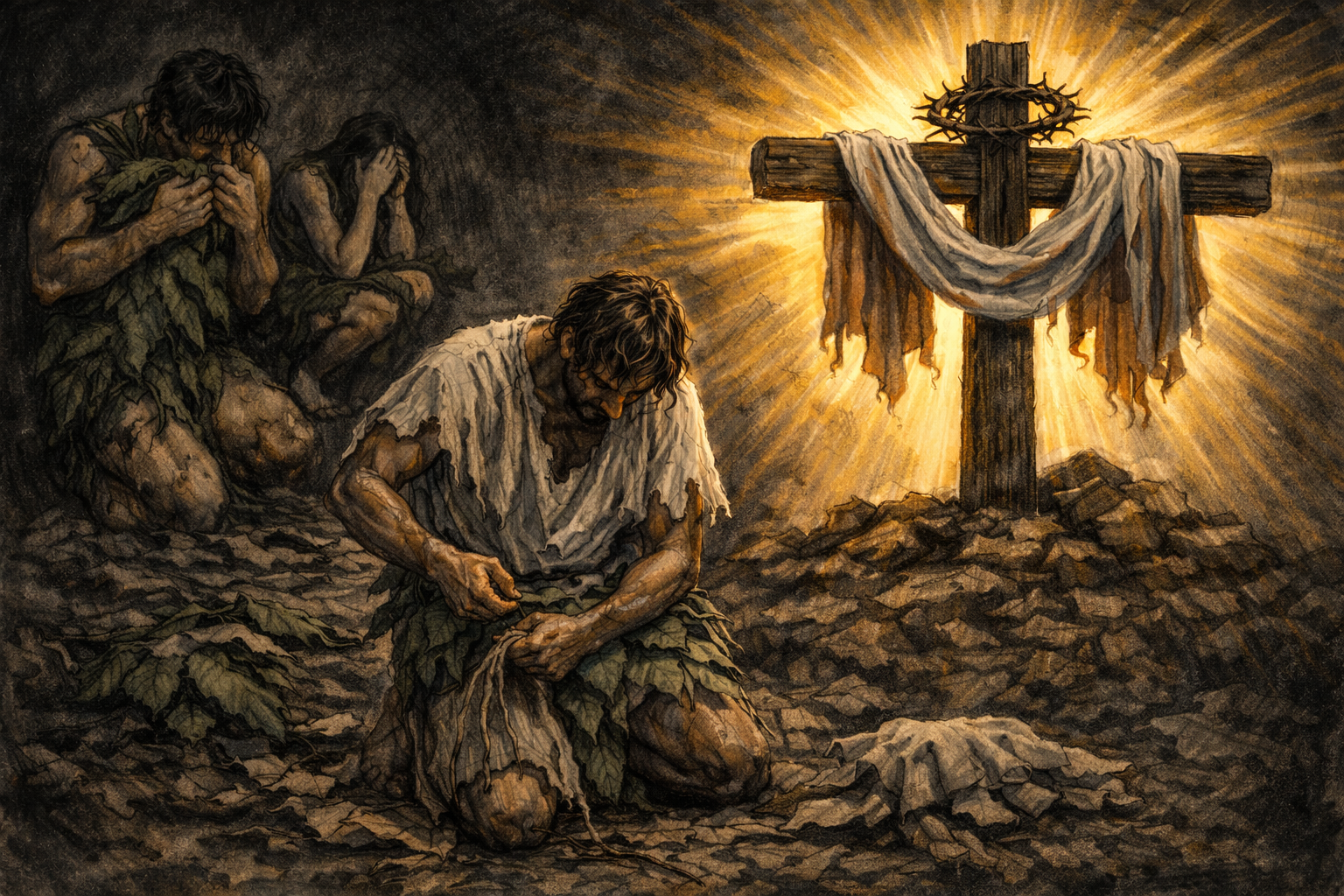
Crowned
“I will greatly rejoice in the Lord;
my soul shall exult in my God,
for he has clothed me with the garments of salvation;
he has covered me with the robe of righteousness...”

Endured
Shame drove them further east,
and sorrow followed.
Now the language of the image bearers
is a chorus of Lamentations—
dust on the head,
tears in the night,
bitterness in the mouth,
the soul weighed down within.

Unclean
While Adam and Eve wore
their God-sewn apparel,
Eden was behind them.
They walked eastward
in covered shame—
clothed by mercy,
but driven from perfection.