The Theology of Interstellar
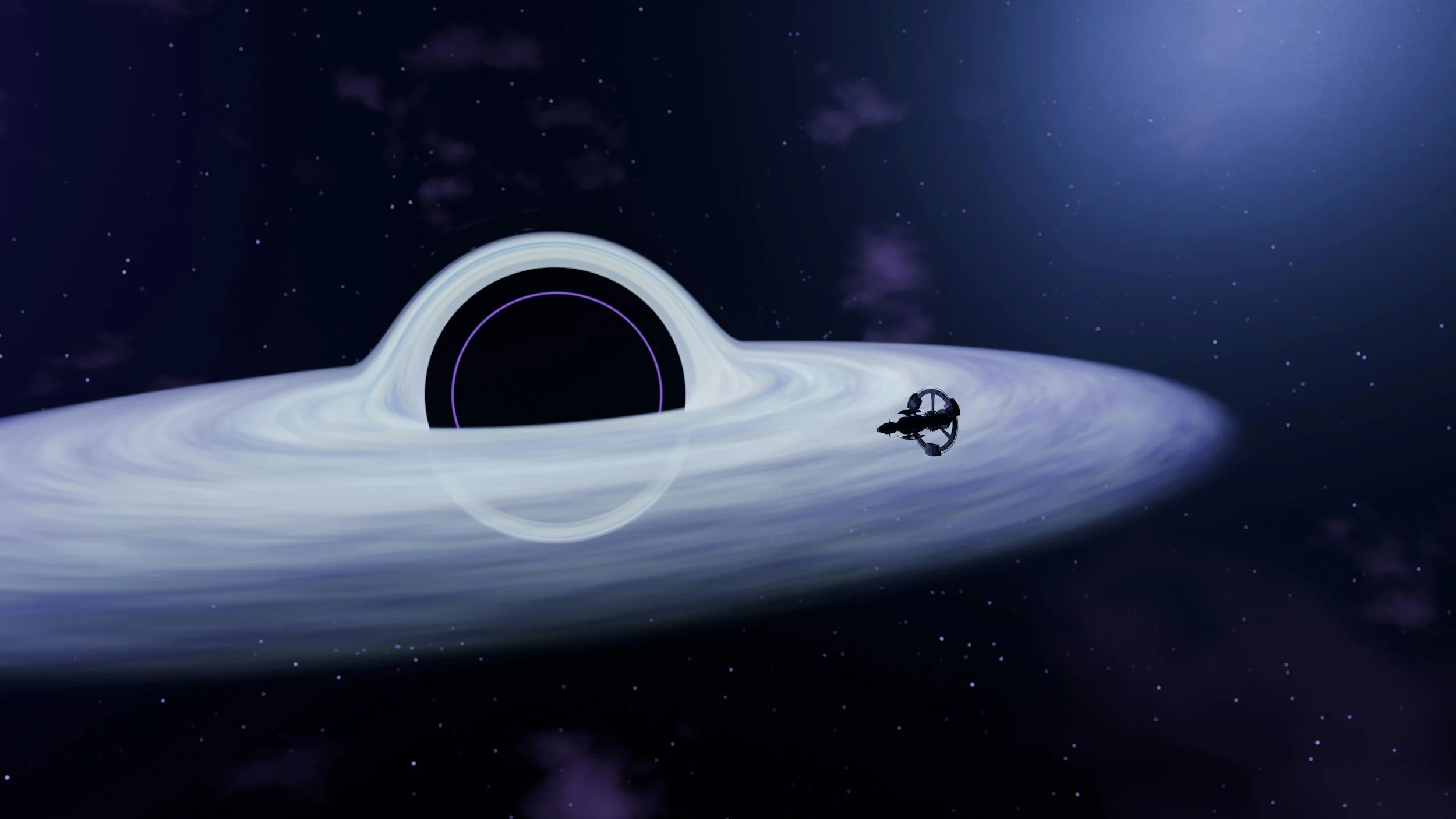
The Black Hole from the movie, Interstellar.
I want to first acknowledge that this analysis of the movie Interstellar may come across as amateurish and incomplete. However, it captures what I consider to be some of the most notable theological concepts presented in the film. I fully recognize that the principles I identify in this movie were likely not intended by Christopher Nolan, yet they exist nonetheless. Everyone possesses a theology, whether they admit it or not. If you have not reflected on the source of your worldview, it is guaranteed that your theology has been shaped by the influences surrounding you. For example, children raised exclusively in Muslim communities often grow into adults with a fatalistic mindset, as that culture is grounded in determinism. During the year I lived in Bahrain, I heard the Arabic phrase “Inshalla,” meaning “If God wills it,” probably ten times a day. Conversely, a child raised in secular America often has a markedly different outlook, believing that they are the masters of their own destinies. America is obsessed with liberty and freedom, which may partly explain why many Westerners cringe at the mention of Calvinism, as it suggests that we may not be as in control of our outcomes as we wish to believe. That said, the great director Mr. Nolan undoubtedly has his own theology, and my purpose today is to explore some aspects of that worldview as reflected in the plot of Interstellar.
Ultimately, this movie describes the parallel journeys of two main characters: “Coop” Cooper, the former NASA pilot played by Matthew McConaughey, and “Murph” Cooper, his brilliant daughter. Coop's journey is a space adventure, while Murph's story is more of a self-realization and coming-of-age narrative, one she must endure without the presence of her brave and self-sacrificing father.
The first significant theme I recognized was the initially Arminian perspective of the plot, which eventually transitions into a peculiar blend of atheism and a non-specific transcendent quality of humanity, if such a concept can even exist. Arminianism is a Christian philosophy placing the responsibility for salvation on the sinner. Arminians argue that salvation is a free offer that individuals can either accept or reject, with each sinner capable of wrestling themselves from death to life by claiming what God has offered to everyone. This raises the question: how sovereign can God be if He desires everyone to be saved, has sent Jesus to die for all, yet not everyone comes to faith? Arminians typically respond that “God is in control, but He allows people to make their own choices.” The logical issue with this view is that if God truly controls creation and knows the ordained outcomes, then what genuine freedom do individuals have to choose salvation or reprobation beyond the preordained result? Independent decision-making (or libertarian free will) cannot genuinely exist under this premise. Nevertheless, the Arminian perspective defends itself with a claim that God's foreknowledge is passively aware of human decisions. This theological tension is evident in the film. It becomes clear to the NASA scientists stranded on a dying Earth that mysterious fifth-dimensional beings have deliberately opened a wormhole to an unknown galaxy, leading to a planet where humanity might survive. NASA embarks on a mission, recruiting ten heroic explorers for separate missions into the wormhole to potentially discover a new home for humanity. The offer of salvation awaits them, and it is simply a matter of choosing life by accepting the freely offered gift. Sound familiar?
However, this interpretative framework undergoes a 180-degree shift near the film's conclusion. It is revealed that Matthew McConaughey’s character has been manipulating the course of scientific discovery from 80 years in the future (the details remain elusive because it’s science fiction), and the enigmatic fifth-dimensional beings we never see are, in fact, future humans looking back to save their own race—a classic time travel paradox. This represents the movie’s most cringeworthy moment for me. Essentially, humanity “matures” over Coop’s 80 years in space—from a nascent, vaguely religious community trusting in some higher power to a society that realizes the “truth” that they alone are capable of saving themselves. They become their own gods—literally. I should despise this plot twist as it profoundly offends my worldview, which insists that I am incapable of saving myself; nevertheless, it aligns with the story as it unfolds. Additionally, it serves as a commentary on the theological state of our society. This film may resonate with many viewers because it reflects what they truly believe about our human condition. Yet, can themes of self-sacrifice, human responsibility, and courage in danger also reflect the nature of God instilled in all of us? Are we the masters of our destinies, or is there something greater guiding the course of human events?
To highlight the complex theology of this film, Nolan fills it with competing values. In a questionable attempt to appeal to various moral frameworks, Christopher Nolan manages to validate multiple ethical systems. Coop’s fellow time-traveling astronaut, Dr. Amelia Brand (played by Anne Hathaway), adheres to a cold utilitarianism while repeatedly asserting that love is limitless. She is willing to abandon the few remaining people on Earth to plant a colony of human embryos on a distant planet, justified by the utilitarian principle that it is acceptable to sacrifice one to save two.
In contrast, Coop operates based on the classic Christian ethic found in John 15:13, which states, “There is no greater love than this: to lay down one’s life for one’s friends.” He demonstrates a willingness to sacrifice himself yet repeatedly finds ways to survive the next catastrophe, all while maintaining the mission’s objectives. Coop leaves his family on a perilous journey to save the planet and later sacrifices himself again to assist Dr. Brand in reaching the only viable planet for humanity’s survival. He embodies a Christ-like figure in the film, though I would describe him more as a version of a "Mormon Jesus" with an Arian influence.
The Arian heresy, which gained traction in the early church, characterized Jesus as a wise man worthy of emulation but not as God. This notion was ultimately rejected at the Council of Nicaea in 325 AD, famously involving St. Nicholas. I refer to Coop as an Arian Jesus because, although he repeatedly sacrifices himself, he remains oblivious to the ultimate outcome or larger purpose. He senses that some force is guiding events, yet he is unaware of who or what that may be.
In a more orthodox interpretation of this story, Coop would embody a kind of hypostatic union, possessing awareness of the future and collaboration with the fifth-dimensional beings orchestrating their own “life raft” to survival in space. The "Mormon" angle of the film is even more pronounced; it echoes the belief in the Mormon worldview that individuals can become gods themselves, paralleling the narrative in which humans transcend their limitations to achieve salvation.
Despite its philosophical conflicts and departure from a traditional Christian worldview, the film concludes on a heartwarming note. One reason I appreciate science fiction is its ability to provoke philosophical inquiries, a hallmark of this genre. The questions posed in Interstellar are indeed contradictory, yet I discern echoes and glimmers of Christian ethics throughout. Ultimately, it is an exceptional story with a remarkable twist. Interstellar is one of my favorite movies of all time, even with its aim to transform viewers into heroic, anti-deterministic glory-seekers within a predestined narrative.