Orange on Saturday, Hope Beyond Sunday: College Football, Community, and Our Identity in Christ
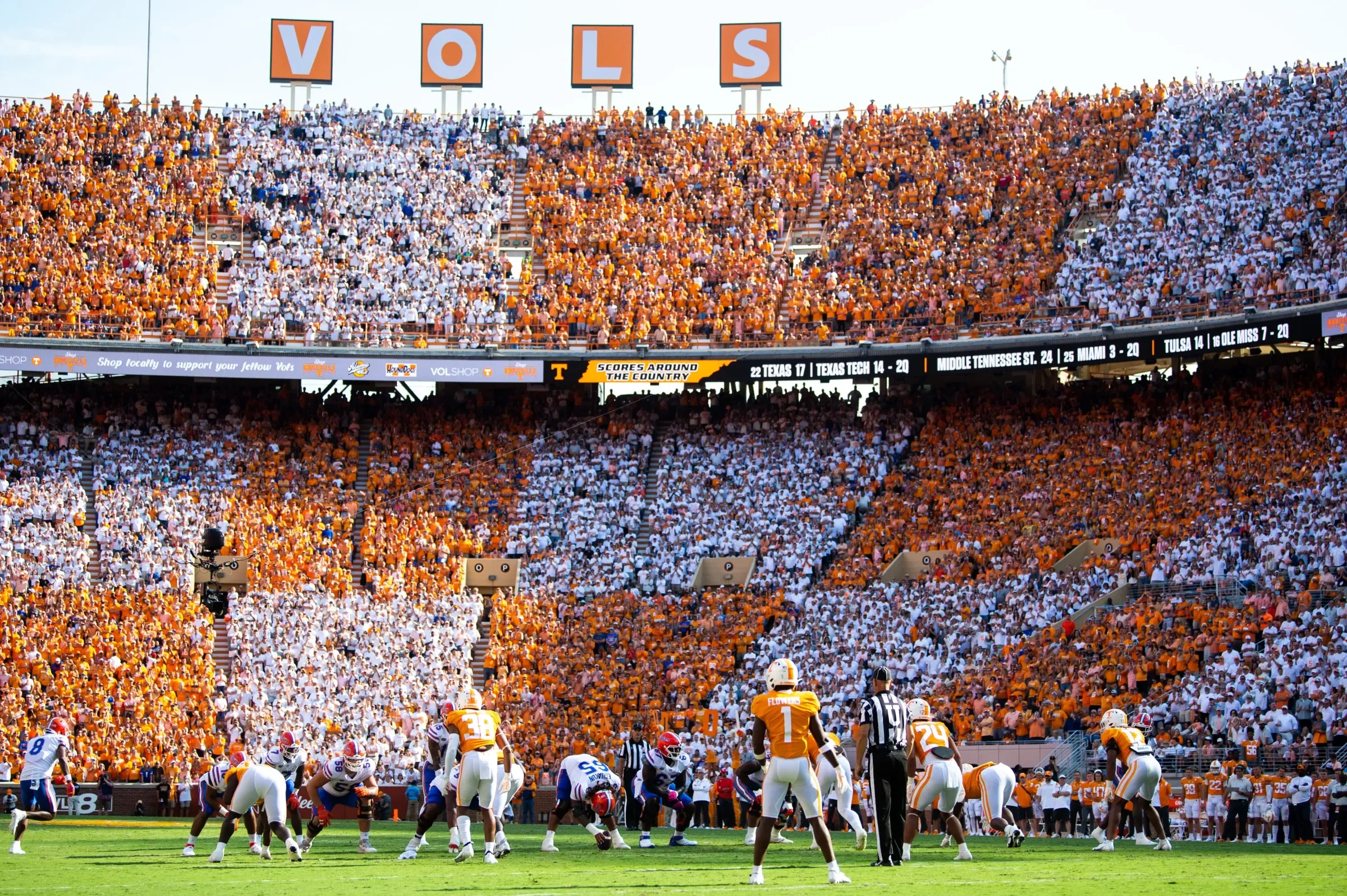
Tennessee vs Florida in 2022
I was on my knees in my sister’s living room in Nashville when the football sailed through the uprights. Tennessee had finally beaten Alabama. After fifteen consecutive losses to our rival, the final kick delivered a 52–49 victory. We shouted, hugged, and celebrated. For a few moments, the years of disappointment gave way to unrestrained joy.
That was October 2022, and I still remember how it felt. I grew up cheering for Tennessee and later attended the university. I love the orange, the checkerboard end zones, the Pride of the Southland Marching Band, and a stadium full of people singing “Rocky Top.” Those traditions belong to the story of my life.
For many people, college football carries that kind of meaning. A game gathers up memories of childhood, family, friendship, and home. The team on the field represents a place and the people with whom we share it.
When I moved back to Tennessee after several years in Indiana, I was reminded how thoroughly college football shapes the rhythms of Southern life. During the fall, Saturday’s game helps organize the weekend. Families plan meals around kickoff. Friends arrive wearing their colors. Neighbors exchange predictions, and the conversation continues at church the next morning.
The game becomes an occasion for belonging.
Wendell Berry’s writing on community helps explain why these attachments matter. He describes community through the recognition that we share a place and that our lives affect one another. We know our neighbors, care about their welfare, and participate in a life that extends beyond our individual concerns. Shared traditions give that life a familiar shape.
Football can be one of those traditions. A child learns the fight song from a parent. Friends prepare a meal together. Someone who rarely opens his home invites people over to watch a game. A team’s colors become an easy beginning to a conversation between strangers. There is something good in these ordinary pleasures.
I saw that attachment from the other side when I attended the Tennessee–Georgia game in Athens later that season. The Bulldogs’ fans were loud, enthusiastic, and thoroughly invested in their team. As a Tennessee fan, I would have preferred a different result. But I understood their enthusiasm. They were sharing a tradition that mattered to them.
The trouble begins when a good attachment gains authority over our hearts. People sometimes joke that football is a religion in the South. The joke can become uncomfortable when we consider how much of our attention, money, energy, and emotional life we give to a team.
A loss can follow us into Sunday. We become irritable with our families, withdraw from friends, or find ourselves unable to enjoy anything else. The result of a game begins to determine whether the weekend was worthwhile. The team’s success feels like our success, and its failure feels like a verdict on us.
Disappointment itself is understandable. Devoted fans care about what happens. But when a game has that much power over us, we should ask what we are depending on it to provide. Has football become a source of worth, security, or hope that it cannot sustain?
Paul addresses a deeper question of confidence and belonging in Philippians 3. He lists the credentials that once distinguished him: his ancestry, his religious standing, his zeal, and his record of obedience. These were serious grounds for boasting within his world. Yet his encounter with Christ changed how he evaluated them.
“But whatever gain I had, I counted as loss for the sake of Christ” (Philippians 3:7). He goes on to speak of “the surpassing worth of knowing Christ Jesus my Lord” (3:8).
Paul’s point reaches beyond rearranging his interests. He has found a new ground of acceptance before God. He wants to be found in Christ, possessing the righteousness that comes through faith rather than a righteousness of his own. He wants to know Christ, share his sufferings, and participate in the life secured by his resurrection.
Football fandom is hardly equivalent to Paul’s former religious confidence. Still, his testimony teaches us to examine the things on which we build our lives. Knowing Christ gives us a way to measure every other attachment. Something may be deeply meaningful without being able to bear the weight of our identity.
After Tennessee lost to Georgia, people approached me at church and asked, “Are you doing okay, Matt?” They knew how much I cared. Earlier in my life, I might have carried that loss into the next day with considerably less grace. Christian maturity includes learning how to receive a disappointment without allowing it to govern our treatment of other people.
I told our church, “I have too much joy in Christ for it to be destroyed by the loss of a football game.” I want that statement to describe my life. It expresses a conviction I need to remember whenever a good thing begins to demand too much from me.
Christ gives us a belonging that survives defeat. Through faith in him, we are received by God, joined to his people, and given a hope that extends beyond the fortunes of this season. That belonging can free us to enjoy a game without asking it to tell us who we are.
CityAlight’s song “Only a Holy God” asks, “What other name remains undefeated?” That line reminds me that Christ’s reign will endure. His victory came through the cross and resurrection, and following him includes suffering. Yet even suffering cannot overturn the hope we have in him. His people belong to a kingdom that will never finally fall.
That hope should shape how we inhabit the places and relationships we have been given. We can host a watch party with generosity, enjoy a rivalry without contempt, and celebrate a victory with gratitude. We can remain attentive to the person beside us when our team loses. Our shared interests become opportunities to love the people with whom we share them.
I will keep wearing orange and singing “Rocky Top.” I will enjoy the memories, the friendships, and the Saturday gatherings. And when those pleasures begin to occupy the place that belongs to Christ, I need to repent and recover Paul’s perspective.
The best gift of a football Saturday may be the people gathered around us. We can receive that gift with open hands because we already belong to Christ. Whatever the scoreboard says, the surpassing worth of knowing him remains.