The Bomb and the Sovereignty of God
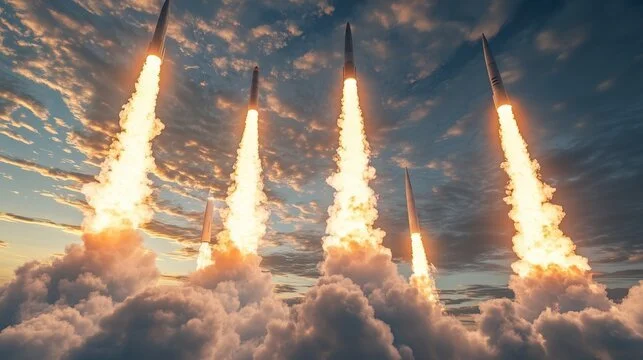
Intercontinental Ballistic Missiles (ICBMs)
As someone born and raised at the end of the Cold War, I have given little thought to nuclear war. Nuclear weapons have felt more like a trope from the spy movies I enjoyed growing up than a genuine threat to my existence.
Recently, unable to sleep, I stayed up late and watched a Netflix film I had added to my watchlist months ago: A House of Dynamite. I knew almost nothing about the plot going in. What unfolded was a sobering story that imagines how key figures within the United States national security apparatus might respond in the midst of a nuclear attack.
The film follows a range of characters, including the President, the Secretary of Defense, the commander of U.S. Strategic Command (STRATCOM), White House Situation Room staff, a missile commander at Fort Greely, Alaska, the National Intelligence Officer for North Korea, and FEMA officials. Its dramatic force lies in how it splinters the crisis across these perspectives, showing the confusion, pressure, and dread that accompany the possibility of nuclear catastrophe.
The movie is loosely inspired by Annie Jacobsen’s chilling nonfiction book, Nuclear War: A Scenario. After watching the film, I immediately began reading her book. One line in particular stayed with me: “The epic, existential tragedy is that these last and final nuclear battle maneuvers cease to matter on anyone’s scorecard. Everyone loses. Everyone.”
That is the horrifying truth at the center of every nuclear scenario: there are no winners, only losers. Former President Reagan commissioned a simulated war game, code-named Proud Prophet, to explore the outcome of nuclear war. The conclusion was grim. In every scenario, the end was the same: complete destruction. Even those who survived the initial exchange would likely face starvation, social collapse, and a ruined world in the aftermath.
The film imagines an intercontinental ballistic missile launched from an unknown source in the Pacific Ocean. We later learn that Chicago is its target. The characters suspect North Korea, though the source is never conclusively established. That uncertainty only deepens the terror. In a matter of minutes, leaders are forced to make civilization-shaping decisions while lacking complete information.
The ending is especially disturbing. The screen goes black just before the missile presumably strikes Chicago. The audience is left to imagine the devastation, while the President, played by Idris Elba, is pressured by STRATCOM to respond with nuclear force. The final moments leave you with the awful sense that once such a chain of events begins, human beings may be unable to stop it.
Perhaps the most devastating scene is the despair of the Secretary of Defense, played by Jared Harris, who walks off the edge of the Pentagon to his death after speaking with his daughter, who lives in Chicago. It is a crushing image: a man entrusted with the command of the most powerful military in history realizing, in a moment of helpless clarity, that he cannot save the people he loves or the nation he serves.
What made the film feel even heavier was reading current analysis afterward and realizing how close these questions remain to the modern world. A March 27, 2026, TIME article argues that conflict with Iran could do more than intensify one regional crisis; it could accelerate nuclear proliferation worldwide. The article notes that the International Atomic Energy Agency reported last year that Iran had stockpiled 408.6 kilograms of uranium enriched to 60%, material that, if further refined, could potentially fuel multiple warheads. It also argues that even if attacks on Iran’s nuclear sites slow its program in the short term, they may strengthen the regime’s conviction that only a nuclear deterrent can guarantee its survival.
That logic does not stop with Iran. The article points out that North Korea has seized on the moment to vindicate its own nuclear posture, while countries long sheltered under American security guarantees may now be reconsidering their dependence. In Europe, discussions about deterrence have sharpened amid fear of Russia. In the Middle East, Saudi Arabia, Turkey, and perhaps Egypt could feel pressure to pursue their own programs if Iran survives and presses ahead. In East Asia, public anxiety has already pushed debate further in South Korea and Japan, where the credibility of the American nuclear umbrella is increasingly questioned.
That is what makes the nuclear question so haunting. It is never only about one bomb, one nation, or one war. It is about the contagious logic of fear. Once one state concludes that survival depends on nuclear weapons, other states begin to reason the same way. Deterrence promises security, but it multiplies the instruments of catastrophe. What begins as protection can become a chain reaction of suspicion, stockpiling, and permanent instability.
As I thought about the film, Jacobsen’s book, and the article, I found myself reflecting not only on nuclear weapons but on human nature itself. Why, knowing the destructive capacity of such weapons, have nations continued to build and stockpile them? Why would humanity create devices capable of annihilating cities and then call their possession a form of security? These questions expose something deeply broken in us. Nuclear weapons are not merely a technological problem; they are a moral one.
They reveal how fear, ambition, pride, and the lust for power can shape nations just as surely as they shape individuals. And they remind us how fragile the illusion of peace really is. In a world marked by war in Ukraine, instability surrounding Iran, and rising tension over Taiwan, it does not take much imagination to see how quickly such weapons could become more than theoretical. The danger is not only that a madman might launch one. The danger is that entire systems of rivalry, deterrence, retaliation, and mistrust have made the unthinkable imaginable.
I also find myself wondering how close the world has come to such disaster in the past. It seems to me that only by the common grace of God has humanity been spared from nuclear catastrophe since the end of World War II. Whatever political calculations, diplomatic efforts, or military restraints have been involved, behind them all stands the mercy of God.
That realization does not make the danger less real, but it does place it in a larger frame. Peace is never finally secured by treaties, stockpiles, or military strategy. True peace is found only in the heart of the one who trusts in the sovereignty of God. In his wisdom, God has permitted a world in which such terrible weapons exist. Yet even now, history is not spinning out of control. The future does not belong to presidents, generals, or dictators. It belongs to God.
For that reason, I believe it is right to labor for restraint, de-escalation, and the prevention of nuclear proliferation. It is right to pray that no new nations acquire such weapons and that those who possess them would act with sobriety and restraint. Yet even beyond political hope, the Christian’s deepest confidence rests elsewhere.
God will bring all things to their appointed end. He will judge evil, put an end to war, and stand glorified over all he has made. His new creation will know nothing of chemical weapons, ICBMs, air raid sirens, or the threat of annihilation. That world will be free from fear because it will be ruled openly and perfectly by the Prince of Peace. I look forward to that day.